
Why Malaysian B2B Leaders are Pivoting to “Trust Ecosystems” for 2026
The 83% Invisible Journey: Why Malaysian B2B Leaders are Pivoting to “Trust Ecosystems” for 2026
1. Introduction: The Death of the Linear Sales Funnel
The Malaysian B2B landscape is undergoing a disruptive structural realignment. This is no longer a matter of incremental digital adoption; it is a fundamental shift in the nation’s economic engine. In 2024, approved digital investments in Malaysia hit a staggering RM 163.6 billion—a 250% year-on-year increase. With the digital economy mandated to contribute 30% to the national GDP by 2030, the traditional, linear B2B sales funnel has effectively collapsed.
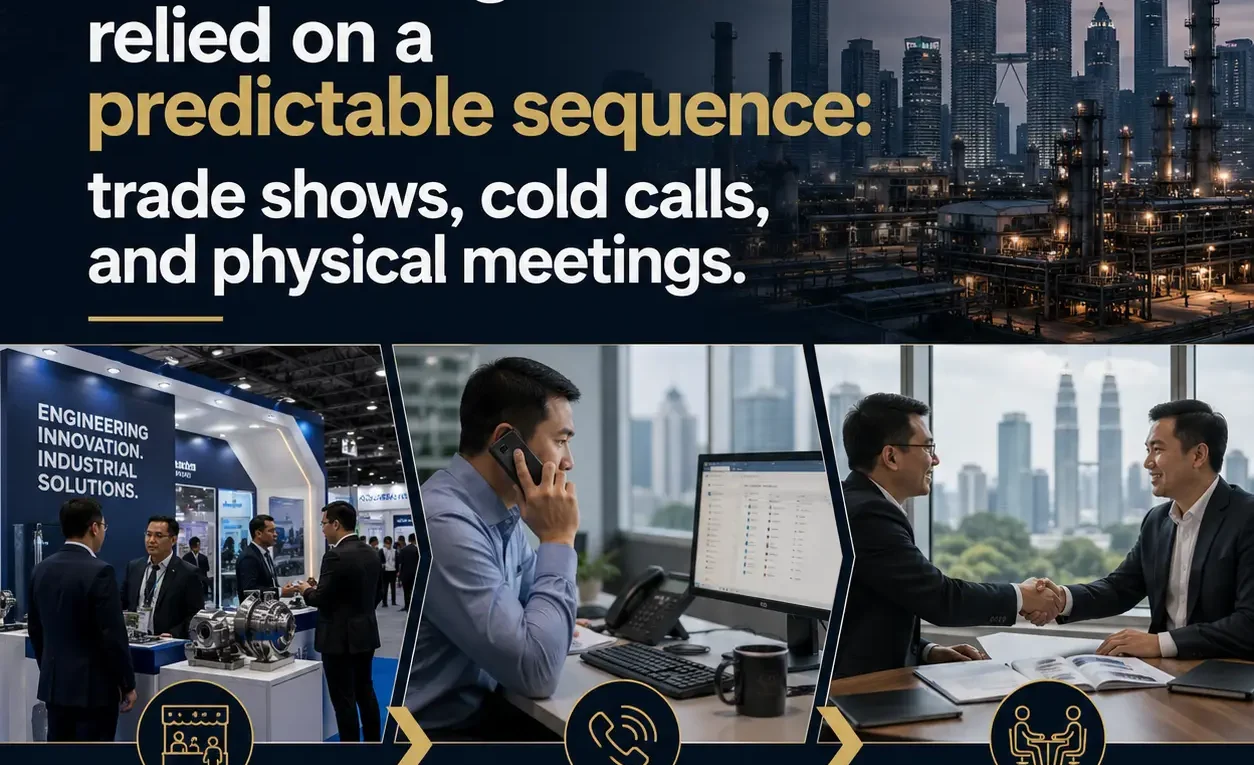
For decades, Malaysian industrial growth relied on a predictable sequence: trade shows, cold calls, and physical meetings. Today, that model is obsolete. The modern Malaysian buyer is a digitally native, self-sufficient researcher who operates in the shadows long before a vendor is even aware of an opportunity. To win in this environment, leaders must stop chasing “leads” and start building “Trust Ecosystems” that capture value in the spaces where sales teams are currently blind.
2. The “Stealth” Buyer: Why 83% of the Journey is Invisible
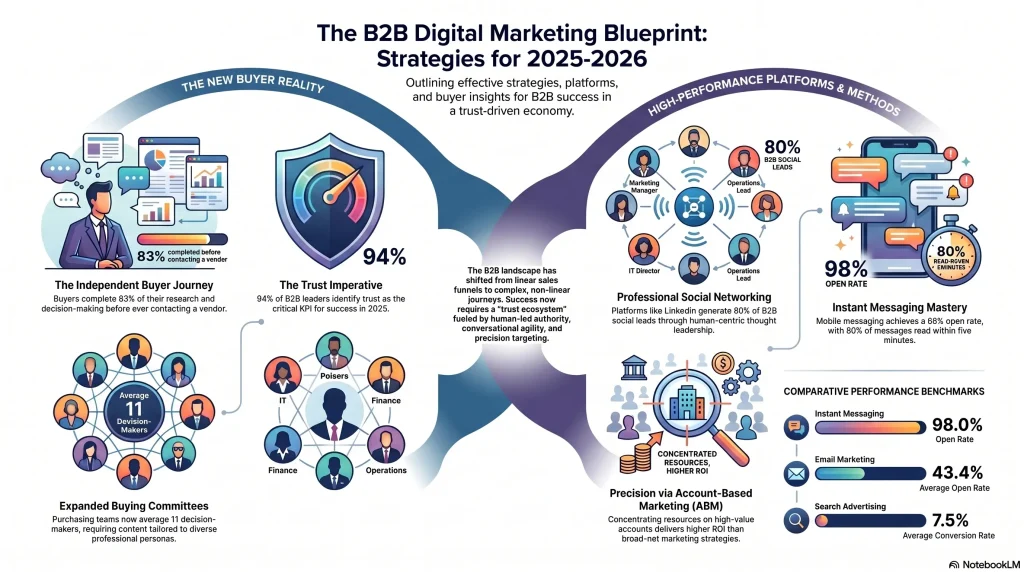
The most critical takeaway for 2025 is the rise of the autonomous buyer. According to recent data, 83% of the B2B buying journey—encompassing independent research, peer validation, and multi-stakeholder consensus—now happens entirely without vendor contact.
Typically, a prospect is 73% of the way through their decision-making process before they ever reach out to a sales representative. This shifts the burden of performance: the marketing department has become the primary “sales force” for the first 12 weeks of interest. If your digital footprint does not provide definitive answers during this “stealth” phase, you are disqualified before the first phone call is even placed.
“The proliferation of low-quality digital content and generative AI has created a significant ‘noise’ problem. Approximately 19% of buyers using AI-powered search tools feel less confident in their purchasing decisions due to concerns over inaccurate or unreliable information.”
3. The Trust Paradox: Human-Led Authority in an AI World
As AI-generated content saturates the market, human authority has become the ultimate premium. In a survey of 1,500 senior B2B marketers, 94% identified “trust” as the critical KPI for 2025. Successful firms are bridging this “AI Confidence Gap” by pivoting toward human-led thought leadership and Social Selling.
This isn’t just about professional profiles; it’s about institutionalizing influence. Sales representatives who actively engage in Social Selling—utilizing the Social Selling Index (SSI) to establish their professional brand and engage with insights—are 51% more likely to reach or exceed their quotas. By moving away from corporate broadcasting and toward employee advocacy, firms can see 561% more reach. Furthermore, the combination of “video + influence” makes a brand 2.2 times more likely to be trusted by Malaysian decision-makers who crave authentic, localized expertise.
4. From “Nets” to “Spears”: The Rise of the 11-Person Buying Committee
Modern Malaysian procurement has moved from individual decision-making to committee-based consensus. In the APAC region, the average B2B purchasing team now includes 11 decision-makers, ranging from technical engineers in Penang’s manufacturing hubs to financial controllers in Kuala Lumpur.
To navigate this complexity, Account-Based Marketing (ABM) has evolved from an enterprise luxury to a strategic necessity. Rather than casting wide nets, growth strategists are using “spears” to target high-value accounts with precision.
| ABM Tier | Target Account Volume | Personalization Depth | Investment Level |
| Strategic ABM | 5 – 25 Accounts | Fully Bespoke (Market of One) | Highest |
| ABM Lite | 25 – 100 Accounts | Semi-Customized (Clusters) | Moderate |
| Programmatic ABM | 100 – 1,000+ Accounts | Scaled / Automated | Lowest |
5. WhatsApp: The Strategic Qualification Gate
In the Malaysian context, LinkedIn is the epicenter for discovery, but WhatsApp Business is the central nervous system for closure. With 86.5% of the population active on the app, it has become the most direct channel for professional communication, boasting 98% open rates and a “read time” of under five minutes.
Crucially, the move from LinkedIn to WhatsApp is now a strategic qualification gate. A prospect’s willingness to transition from a professional platform to a “personal” messaging space is the highest indicator of intent in the Malaysian market.
Strategic Insight: B2B firms that integrate WhatsApp with their CRM systems—facilitating real-time proposals and automated “speed to lead” responses—report a 28–32% increase in closure rates and up to 70% time savings per sales representative.
6. Answer Engine Optimization (AEO): Winning the “Zero-Click” Search
The search landscape is shifting from traditional SEO to Answer Engine Optimization (AEO). As Google’s AI Overviews and Perplexity provide direct summaries, organic click volume may decrease. However, there is a distinct silver lining: 58% of marketers report that AI-referral traffic is of significantly higher intent.
To win in the AEO era, Malaysian firms must adopt a mobile-first technical strategy, as 9 in 10 Malaysians access the internet via mobile devices. This requires:
- Structured Data & FAQ Schema: Optimized for AI bots to scrape and summarize.
- Pillar Pages: Establishing domain authority on complex industrial topics.
- Localized Geo-Targeting: Using metadata specific to hubs like Kuala Lumpur and Penang.
- Linguistic Nuance: Incorporating Bahasa Malaysia and Mandarin to capture niche SME interest in non-urban areas.
7. The Institutional Edge: Leveraging “MyDIGITAL” and MDT
Top-tier Malaysian B2B firms are no longer operating in isolation; they are aligning with national economic tailwinds. Programs like the New Industrial Master Plan (NIMP 2030) and the Malaysia Digital Acceleration Grant (MDAG-AI) provide significant financial leverage, with grants covering up to 70% of project costs (capped at RM 2 million).
Beyond funding, strategic alignment with the MADANI Digital Trade (MDT) platform is becoming essential. For firms looking to win contracts with Government-Linked Companies (GLCs) and large corporations, MDT provides a framework for cross-border commerce, business matchmaking, and market intelligence. Aligning your marketing narrative with these national transformation goals is now a core requirement for institutional trust.
8. Conclusion: The Unified High-Tech, High-Touch Future
The B2B winner in 2026 will not be the company with the largest advertising budget, but the one that masterfully balances high-tech efficiency with high-touch human expertise. The “Trust Ecosystem” is built on AI-driven precision and human-verified authority.
As you audit your growth strategy for the coming year, ask yourself: Is your digital presence robust enough to satisfy an 11-person committee for 12 weeks before they ever speak to your team? If you cannot see the 83% of the journey your buyers are currently taking, you are already losing the race to the competitor who can.
