
The One-Person Business Revolution
Why Specialization is for Insects and Your Life is the Product
1. The Hustle Culture Paradox
The algorithm rewards the performative exhaustion of the 16-hour grind, but the math of the creator economy favors the 4-hour leverage play. Social media frequently promotes a “hustle” mindset that is fundamentally broken it prioritizes raw exertion over systemic efficiency. The counter-intuitive reality is that a focused 2–4 hour workday produces higher quality output because it prioritizes asymmetric upside and strategic rest over mindless “busyness.”
The internet has fundamentally shifted the economic landscape, empowering individuals to build businesses around their personal evolution rather than a stagnant job title. We are witnessing a transition from the corporate employee to the sovereign individual. Your business is no longer just a way to pay bills; it is a vessel for your own growth, interests, and problem-solving, turned into a sustainable creative income.
2. The Case Against Specialization
Traditional career advice urges you to pick a niche and stay there. However, in an AI-driven economy, specialists are “primed for automation.” If your work can be distilled into a repeatable, one-dimensional manual, you are essentially a robot in a human suit and you will be replaced by a cheaper, faster piece of software.
True security belongs to the multi-dimensional generalist who moves artfully between different domains. This is the “Human Path.” As Robert A. Heinlein famously wrote:
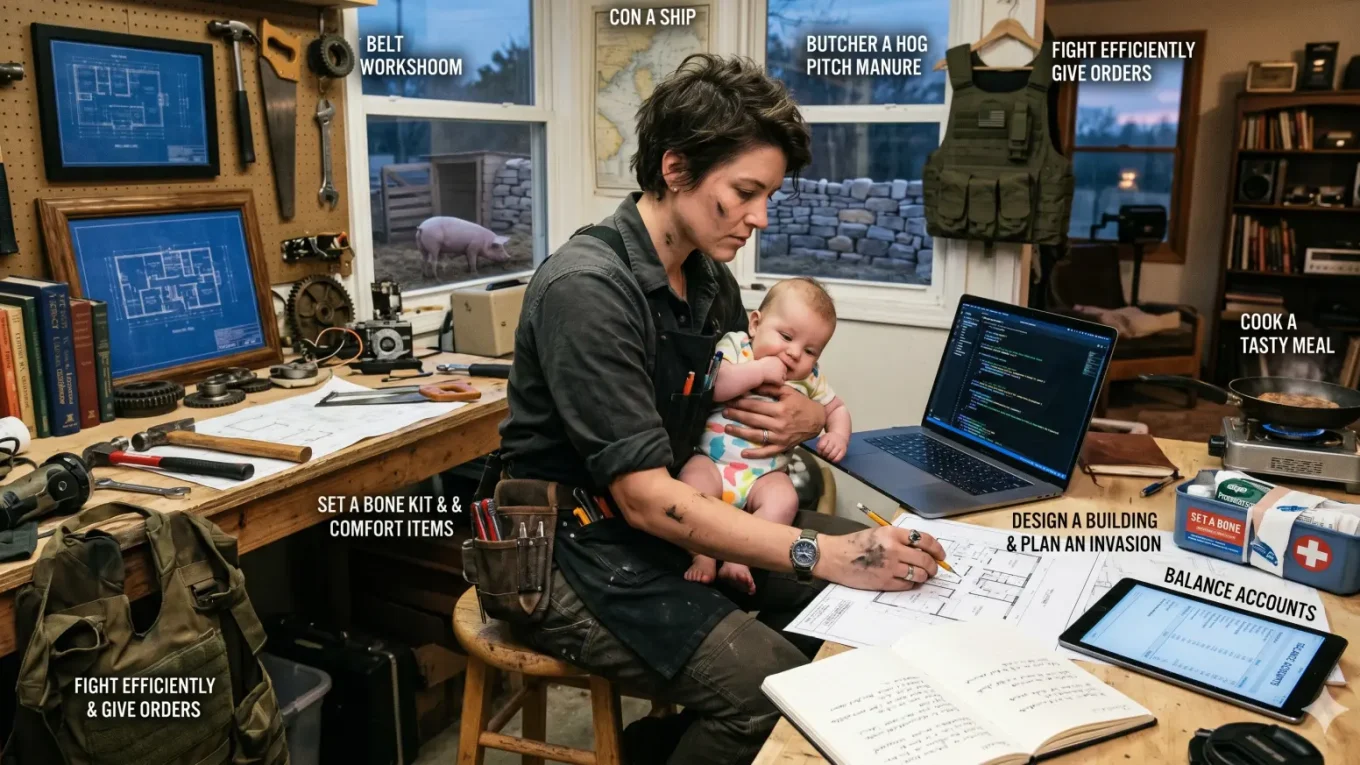
“A human being should be able to change a diaper, plan an invasion, butcher a hog, con a ship, design a building, write a sonnet, balance accounts, build a wall, set a bone, comfort the dying, take orders, give orders, cooperate, act alone, solve equations, analyze a new problem, pitch manure, program a computer, cook a tasty meal, fight efficiently, die gallantly. Specialization is for insects.”
By combining disparate skills, you create a unique “Domain of Mastery” that AI cannot replicate. This is how you achieve autonomy: by being too complex to automate.
3. The “Work Less, Earn More” Systemic Shift
The motto “Work less, earn more, enjoy life” isn’t a call to laziness; it’s a strategic directive. To work less, you must apply force not through physical exertion, but through the creation of systems. Hustle is manual; force is systemic.
When you limit your working hours, you force yourself to build solutions that decouple your income from your time. “Earning more” is a result of moving away from selling hours and toward selling systems and results. This shift allows for the location freedom and time sovereignty that the traditional 9-to-5 intentionally denies you.
4. The Digital Nomad Trap vs. True Sustainability
The “beachfront lifestyle” promoted by influencers is a dopamine-heavy highlight reel. In reality, the sun glare makes your screen unreadable, the heat is oppressive, and the Wi-Fi is garbage. Chasing this cliché is just another form of external validation.
True lifestyle design is achieved through trial, error, and radical self-reflection. It’s about figuring out what you actually want, not what looks good on a feed. Sustainability and moderation are the goals. The “sovereign” creator doesn’t need a laptop on a beach; they need a system that allows them to work from anywhere while maintaining the focus required to actually produce value.
5. Your Life is the Ultimate Business Niche
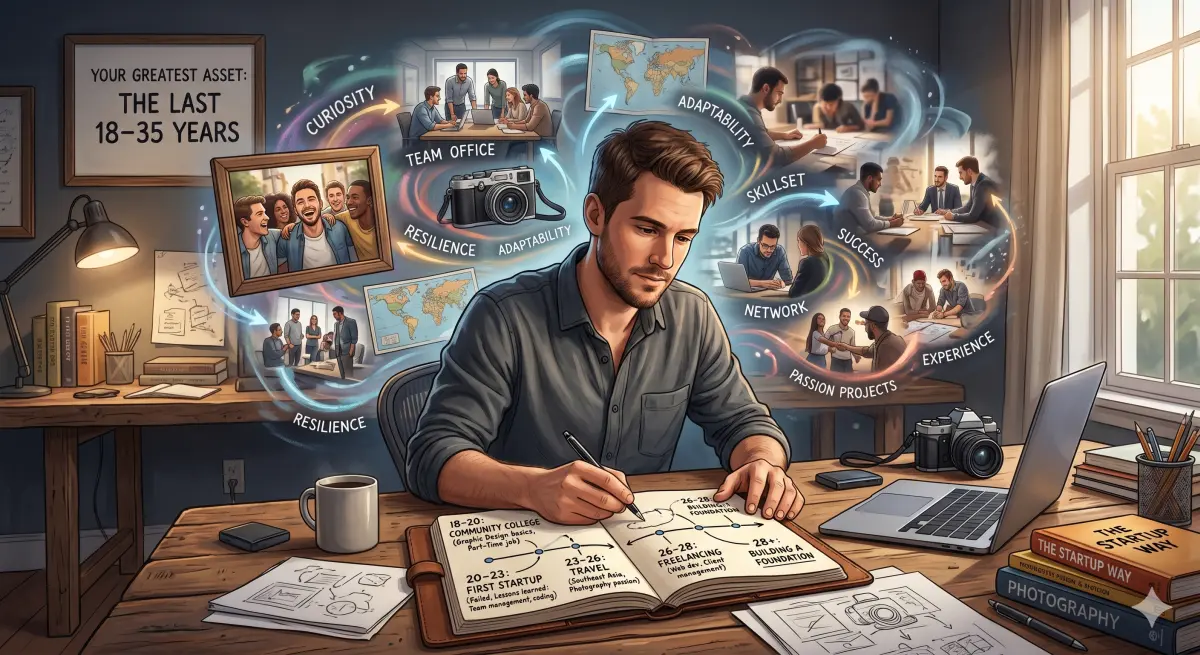
Most people fail because they try to pick a niche out of thin air. They ignore their greatest asset: the last 18–35 years of their life. Your “niche” is simply the problems you have solved and the goals you have pursued.
In the Development-Based Path (Path 2), you are the product. You pursue your own goals, document the roadblocks, and then teach others how to overcome those same hurdles. This creates a business that evolves as you do. You aren’t trapped by a brand; your brand is a reflection of your self-actualization.
6. The Hybrid Path and the Minimum Viable Offer
Many struggle with “Imposter Syndrome” because they haven’t yet mastered a high-value skill. This is where The Hybrid Path (Path 3) becomes powerful: you use your own business as a laboratory.
You practice skills like copywriting, web design, or content strategy on your own brand first. Once you have results, you sell those skills to others. For example, you build your own landing page, see it convert, and then sell landing page design to other creators for 1,000–2,000.
To start, you need a Minimum Viable Offer (MVO). Stop waiting for a perfect digital course. Launch one of the following:
- A Single Freelance Skill: (Done-for-you) Web design or email marketing for 500–1,000.
- High-Touch Consulting: (Done-with-you) A four-call pack for 500–1,000. Examples include neural hacking consulting, bodybuilding coaching, or digital tutoring in a specific software.
The MVO is a data-gathering tool. You must “get the shit out of the faucet so clear water can flow.” Your first offer will be imperfect, but it provides the real-world feedback needed to eventually build a scalable digital product.
7. The Four Pillars of a Sovereign Business
To build a business that reflects your life, you must define your Domain of Mastery by choosing three interests:
- Money: An interest with high market demand.
- Excitement: Something you are genuinely curious about.
- Development: A path involving psychology, philosophy, or self-improvement.
Once these are identified, you map them onto the Four Pillars:
- Goals (Your Brand): What are you leading people toward? (e.g., “Helping 1,000 people achieve financial sovereignty by 2025”).
- Problems (Your Content): The roadblocks you encounter. Sharing how you solve these is your primary value-add.
- Systems (Your Product): Your step-by-step method for solving those problems faster. This is what people pay for.
- Benefits (Your Marketing): How your journey has changed your life. Use benefit-rich language to explain why your message matters.
8. Conclusion: A New Era of Self-Reliance
We are witnessing an inevitable economic migration. Traditional institutions are failing because their curriculum is tied to corporate-government structures that cannot pivot. They are training people for a world that no longer exists.
The new education system is composed of individuals sovereign creators who distill their real-world experience into actionable knowledge. Business is the ultimate vessel for self-transcendence; it forces you to clarify your thoughts, take personal responsibility, and impact the world.
If you want true happiness, you must value self-reliance. Ask yourself: “If your daily life became the blueprint for your business, would you be proud of the product you’re building?”
Related Reading Is the AI One-Person Business Really Reliable? What Businesses Should Consider Before Choosing a Vendor